
Last updated: October 30, 2026
An enclosed stairway does not have to feel like a dark tunnel. With layered lighting, thoughtful wall colour and one strong focal point, even a boxed-in staircase with no natural light can feel bright and welcoming. The trick, as the team at Activemyhouse sees it, is restraint: colour, light and one focal element working together — not three ideas competing at once.
Key Takeaways
- An enclosed stairway feels dark because of little or no natural light plus narrow walls — the fix is layered, not a single trick.
- White, cream, light grey and pale beige walls reflect artificial light best; a satin or eggshell finish adds brightness with a subtle sheen.
- Dark colours are not wrong: deep blue, forest green and charcoal can feel cosy and hide scuffs better on a high-traffic stairway.
- One overhead fixture is never enough — layer a pendant, wall sconces and step lighting or LED strips for brightness and safety.
- Give the eye one focal point: a mirror at the landing, a gallery of frames ascending with the stairs, or a statement wall.
- A stair runner in wool or a synthetic blend handles heavy traffic; fit it securely, keep lighting bright enough to see every step, and never block the handrail.
Why Enclosed Stairways Feel So Dark
An enclosed stairway — walls on both sides, no window, sometimes not even a gap to borrow light from a hallway — is one of the hardest spaces in a home to decorate. With little or no natural light and narrow walls closing in, the space reads dark and boxed-in no matter how nice the rest of the house looks.
The fix does not require knocking through a wall or adding a window. Structural changes are the one thing this article will not recommend, because the whole point is what works without them. Instead, the solution is layered: wall colour that works with your artificial light, lighting from more than one direction, and a single focal element for the eye to land on.
Light Colours vs. Dark Colours: An Honest Look
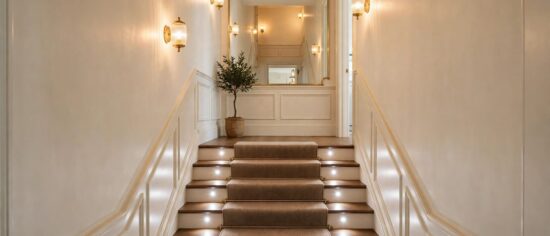
The most common advice for a dark stairway is “paint it white,” and there is real truth behind it. White, cream, light grey and pale beige walls reflect artificial light better than any other choice, which matters enormously with no daylight to bounce around. A satin or eggshell finish takes this further — its subtle sheen catches and spreads light in a way flat paint cannot. Pairing lighter walls with a stair runner, rather than wall-to-wall carpet, also helps the space read wider than it is.
But dark colours are not automatically wrong. Deep blues, forest greens and charcoal can create a cosy, intimate feel rather than making the space feel cramped — a jewel-box effect instead of a tunnel effect. There is a practical argument too: on a high-traffic stairway, dark paint hides scuffs and fingerprints far better than pale walls.
So the real rule is not “always paint it white.” Light colours make the stairway feel brighter and wider; dark colours make it feel cosier and more forgiving of wear. Pick the mood you want to live with and commit to it — a half-hearted mid-tone usually delivers neither.
Layer Your Lighting: One Fixture Is Never Enough
A single overhead fixture throws light straight down, leaves the corners in shadow, and turns the stairwell into a patchwork of bright spots and dark edges. What works is layering.
Start with an overhead pendant or small chandelier as the base layer of general light. Add wall sconces to kill the dark corners a ceiling fixture cannot reach; on narrow walls, slim sconces add light without eating into walking space. Then add step lighting or LED strips along the treads or under the handrail — modern-looking, and a genuine safety upgrade that makes each step clearly visible where there is no daylight. Recessed lights set into the walls at floor level add a warm finishing glow.
One caution: anything beyond a plug-in fitting — step lights, recessed panels, new sconce positions — means new wiring, and that is a job for a qualified electrician, not a weekend DIY project.
Give the Eye One Place to Land
In a narrow, enclosed space, decoration needs discipline: one focal point, not three competing for attention. A statement wall in bold paint or vertical-stripe wallpaper can transform the climb: stripes draw the eye upward so the stairwell feels taller, while a textured grasscloth adds warmth. Keep the other walls quiet so the statement wall reads as a statement.
A large mirror at the landing or the top of the stairs is one of the most effective tricks here. It elongates the stairway visually and bounces your artificial light back into the space, effectively doubling the brightness of your lighting layers.
A gallery wall works with one condition: use large matching frames arranged to ascend in step with the stairs, mirrored on the opposite wall if you like. The repetition creates rhythm, which reads as intentional rather than cluttered. Skip busy florals or large-scale patterns — on a narrow wall they feel chaotic instead of decorated.
Runners, Painted Stairs and Panelling
A stair runner in wool or a synthetic blend copes best with heavy stair traffic, holding its appearance far longer than cheaper options. Medium tones are the practical middle ground: pale runners show every mark within weeks, while very dark ones can look flat. A runner also breaks up the expanse of the staircase and helps the space feel wider than wall-to-wall carpet would.
Painted stairs are another strong option. Painting the stairs a light, bright colour — with skirting boards and panelling in the same colour — adds perceived height, because the eye reads the whole assembly as one continuous surface. Panelling up to picture-rail height adds character and a finished feel without narrowing the space, which is the constant risk in an enclosed stairway.
Keep It Safe
Three rules are non-negotiable. First, a runner must be fitted securely — no loose edges or curling corners on the treads, where a caught toe can cause a fall. Second, lighting must be bright enough to see each step clearly; mood lighting is fine as an accent, but the base layer has to do the practical job. Third, nothing decorative should narrow the walking width or block the handrail — a low-hung frame, a chunky shelf, or a runner creeping past the handrail all fail this test. Style the stairway, but keep it a stairway first.
Enclosed Stairway Decorating at a Glance
| Layer | Option | Why It Works | Source |
|---|---|---|---|
| Lighting | Overhead pendant or chandelier | Provides the base layer of general light | Livingetc |
| Lighting | Wall sconces | Kill dark corners a ceiling fixture misses | Checkatrade |
| Lighting | Step lights or LED strips | Make each step visible; add a modern glow | Home Briefings |
| Colour | White, cream, light grey, pale beige | Reflect artificial light best in windowless spaces | Feifers |
| Colour | Deep blue, forest green, charcoal | Cosy feel; hide scuffs on high-traffic stairs | Checkatrade |
| Focal point | Large mirror at the landing | Elongates the space and bounces light | Artourney |
Frequently Asked Questions
Should I paint my enclosed stairway white?
Not necessarily. Pale colours reflect artificial light best and feel brighter and wider — but deep blues, forest greens and charcoal are equally valid, creating a cosy feel and hiding scuffs better on busy stairs. Choose the mood you want, not a rule that says pale is always right.
What lighting works best in a stairway with no natural light?
Layered lighting: an overhead pendant or chandelier for general light, wall sconces to eliminate dark corners, and step lighting or LED strips along the treads or under the handrail so every step is clearly visible. Anything involving new wiring should be installed by a qualified electrician.
Does a mirror really help in a narrow stairway?
Yes. A large mirror at the landing or the top of the stairs visually elongates the space and bounces your artificial lighting back into the stairwell, multiplying the brightness of the fixtures you have. It is one of the highest-impact, lowest-effort changes you can make.
Can I put a runner on painted stairs?
Yes, and it is a popular combination. Choose a runner in wool or a synthetic blend for durability, pick a medium tone that will not show every mark, and have it fitted securely with no loose edges on the treads. Painting the stairs a light colour underneath adds perceived height even where the runner covers the centre.
Is it safe to hang pictures on a stairway wall?
Yes, as long as you keep the walking width and the handrail clear. Use large matching frames arranged to ascend in step with the stairs, hung high enough that nobody brushes them, and never let a frame or shelf encroach on the handrail. If in doubt, the opposite wall or the landing is the safer spot.
Conclusion
An enclosed stairway rewards a layered approach: wall colour chosen for the mood you want, lighting built up in layers rather than left to a single fixture, one focal point that gives the eye somewhere to rest, and a runner that handles the traffic. Whether you go pale and bright or deep and cosy, these enclosed stairway decorating ideas work without any structural changes — just light, colour and a little discipline.