
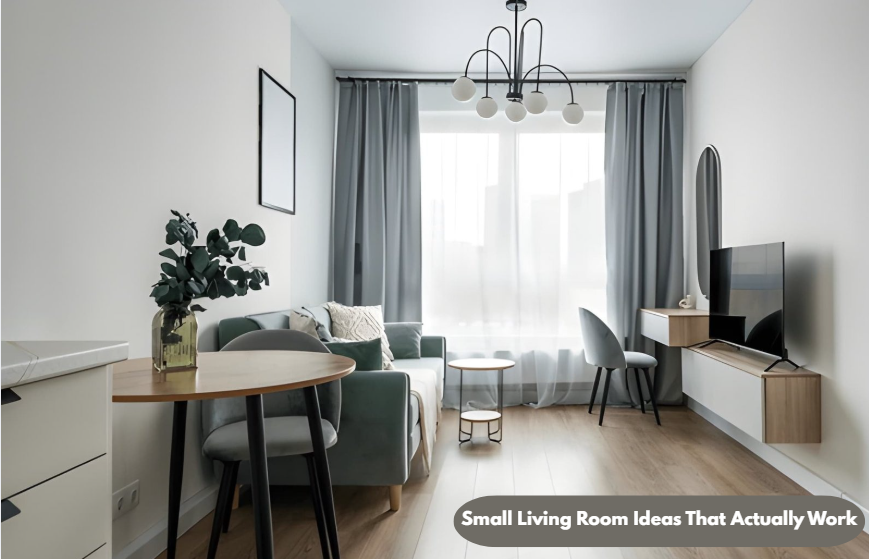
There’s a running joke among apartment dwellers: the living room is wherever you put the couch. If you’ve ever stared at a tiny space and wondered how to make it feel like a place people actually want to hang out in—not a walk-in closet with a TV—you are not alone. The good news? Small living rooms don’t have to feel small. With the right moves, they can feel cozy, intentional, and genuinely livable.
Here Are Small Living Room Ideas That Actually Work
Start With the Layout Before You Buy Anything
Most people make the mistake of buying furniture first and figuring out the layout later. In a small living room, that’s a recipe for a room that feels like a furniture showroom with nowhere to breathe.
Measure your space. Tape out the footprint of sofas and chairs on the floor before committing. Leave at least 18 inches between seating and the coffee table, and make sure there’s a clear path to walk through without turning sideways.
One underrated layout trick: float your furniture away from the walls. It feels counterintuitive—shouldn’t things be pushed back to create space? — but pulling a sofa a few inches off the wall actually makes a room feel larger. It creates visual breathing room and a sense of intentional arrangement rather than furniture hugging the perimeter out of fear.
Furniture That Does Two Jobs
In a small living room, every piece of furniture should earn its place. If something only does one thing, it needs to work harder or leave.
A storage ottoman replaces a coffee table and gives you somewhere to stash blankets, remotes, and the things you shove under the couch when guests arrive. A sofa with built-in storage under the cushions is worth the upgrade. Nesting tables can expand when you need them and disappear when you don’t.
- Designer Pro-Tip: To keep the room feeling airy, choose furniture with slender, exposed legs and materials like glass or acrylic—they provide function without adding visual weight.
Wall-mounted shelving is one of the best investments in a tight space. It draws the eye upward, which makes ceilings feel higher, and it keeps the floor clear—which is the single biggest visual trick for making a room feel open.
For more ideas on how furniture choices impact the feel of a space, the team at https//decoratoradvice.com has published some genuinely useful guides on matching scale to room size, which is something most people overlook entirely.
Color Is Doing More Work Than You Think
Light colors make rooms feel bigger—you’ve heard this. But it’s more nuanced than “paint everything white and call it a day.”
The real goal is to reduce visual contrast between surfaces. When your walls, ceiling, and trim are all close in tone, the eye can’t easily find where one ends and another begins. The room reads as one continuous space instead of a box. This is why painting your ceiling the same color as your walls — or even a slightly lighter version — works so well in small rooms.
That said, you don’t have to live in an all-white box. A deep, moody color on a single accent wall can actually work in a small room if the rest of the space is light. It adds depth rather than closing things in. The key is contrast control: pick your moment, not every surface.
Rugs also define and anchor a space. In a small living room, go bigger than you think you need. Everything appears to be floating when the carpeting is too small. Aim for the front legs of your sofa and chairs to sit on the rug—that’s the sweet spot.
Light Changes Everything
Natural light is your best friend, and blocking it is the most common mistake people make. Heavy drapes, furniture placed in front of windows, dark blinds that stay half-closed—these things make a room feel like a cave.
Hang curtains close to the ceiling and let them extend wider than the window frame on both sides. This makes the window look bigger and lets in maximum light when the curtains are open. Sheer panels let light through even when drawn.
A storage ottoman replaces a coffee table and gives you somewhere to stash blankets, remotes, and the things you shove under the couch when guests arrive. A sofa with built-in storage under the cushions is worth the upgrade. Nesting tables can expand when you need them and disappear when you don’t.
- Designer Pro-Tip: To keep the room feeling airy, choose furniture with slender, exposed legs and materials like glass or acrylic—they provide function without adding visual weight.
The oldest and most effective tactic in the small-room repertoire is the use of mirrors. The illusion of depth is produced by a large mirror on the wall across from a window, which reflects natural light throughout the space. It doesn’t have to be a plain rectangle—an interestingly shaped mirror becomes a design element in its own right.
Vertical Space Is Wasted Space (In Most Small Rooms)
Look up. How much of your vertical space are you actually using?
Floor-to-ceiling bookshelves or built-ins make a room feel taller while giving you enormous storage capacity. Even simple floating shelves stacked high pull the eye upward and make walls feel like they’re doing something useful.
In a small living room, the temptation is to keep things low and minimal. That’s fine for the floor, but the upper half of your walls is prime real estate. Use it for shelving, art hung slightly higher than usual, or a statement light fixture that draws the eye upward.
Declutter, But Make It Look Intentional
There’s a difference between a minimal room and a sparse one. Minimal feels edited and purposeful. Sparse feels like you just moved in and haven’t unpacked.
The goal in a small living room is intentional density — a few carefully chosen objects that feel curated rather than accumulated. One bookshelf styled thoughtfully beats three shelves stuffed with random objects. A single large piece of art beats a gallery wall crammed with small frames every time—it unifies the wall rather than breaking it into chaotic fragments.
If you’re not sure what to keep visible and what to hide, a useful rule is this: if you use it every day, find a stylish way to display it; if you use it occasionally, store it; if you haven’t used it in six months, it’s probably not earning its place in your small living room.
For ongoing inspiration on styling small spaces with personality rather than just practicality, latest decoratoradvice .com is worth bookmarking—there’s a solid mix of real-world ideas and room-specific breakdowns that go deeper than the usual generic advice.
The Mindset Shift That Changes Everything
Here’s the honest truth about small living rooms: the goal isn’t to trick anyone into thinking the space is bigger than it is. The goal is to make it feel comfortable, intentional, and genuinely pleasant to be in.
Some of the world’s most exquisite living rooms are compact. What they have in common isn’t square footage—it’s a clear point of view, furniture that fits, and an absence of things that don’t belong.
Stop apologizing for the size of your space and start working with it. Scale down the furniture. Clear the floor. Let light in. Use your walls. Edit what’s on display.
A small living room that’s been thoughtfully arranged will always feel better than a large one that hasn’t. The size was never the problem. It was always about knowing what to do with it.
Whether you’re dealing with a studio apartment, a starter home, or just a room that never quite comes together—these principles apply. Tweak, experiment, and don’t be afraid to rearrange. Good rooms rarely happen by accident.