
Last updated: October 26, 2026
Cypress trees are a group of more than 140 cone-bearing species, not one tree, and the right choice depends on your yard and climate. Italian cypress suits narrow formal spaces, Leyland cypress grows fast for privacy, and bald cypress thrives in wet soil where most other cypress would rot.
Key Takeaways
- “Cypress” covers more than 140 species in the Cupressaceae family, so always choose by species, not by the name alone.
- Italian cypress grows 40–70 feet tall but only 3–5 feet wide, making it the classic narrow column for formal and Mediterranean-style gardens.
- Leyland cypress grows 3–4 feet per year and reaches 60–70 feet — one of the fastest privacy hedges available.
- Bald cypress is the wet-soil exception: it tolerates standing water and even grows woody “knees” above the ground.
- Most cypress trees want full sun and well-draining soil, but bald cypress wants wet ground.
What Types of Cypress Trees Grow in the US?
Five types cover most American gardens.
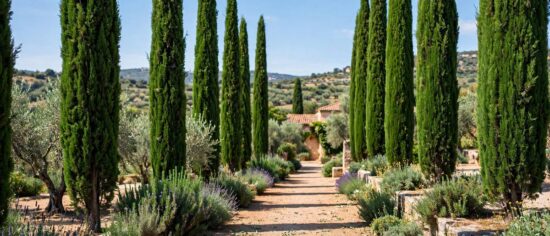
Italian cypress, also called Mediterranean cypress (Cupressus sempervirens), is the tall, pencil-thin column seen along driveways and in formal gardens. It reaches 40–70 feet tall with a spread of only 3–5 feet, and once established it handles drought well.
Leyland cypress is a fast-growing hybrid used mainly for privacy hedges and windbreaks. It reaches 60–70 feet tall with a spread of 15–20 feet, and it grows 3–4 feet per year — fast enough to screen a yard quickly, but it needs room to stay under control.
Bald cypress (Taxodium distichum) is the odd one out. It grows 50–70 feet tall with a spread of 20–45 feet, and it is hardy in zones 4–9. Unlike most conifers, it is deciduous: its feathery needles turn gold in fall and drop for winter. It is also the one cypress that tolerates standing water, and in wet ground it grows woody “knees” that poke up from the soil.
Monterey cypress is a coastal California native built for wind and salt spray, growing 30–70 feet tall. Arizona cypress suits dry, arid regions, reaching about 40 feet with blue-green foliage.
How Tall Do Cypress Trees Get?
Italian and Leyland cypress are the giants, both reaching 60–70 feet. Bald cypress is nearly as tall at 50–70 feet, Monterey varies from 30 to 70 feet, and Arizona is the shortest at around 40 feet.
The table below compares the five at a glance:
| Type | Height | Spread | Best For | Source |
|---|---|---|---|---|
| Italian cypress | 40–70 ft | 3–5 ft | Narrow formal columns, driveways | The Spruce |
| Leyland cypress | 60–70 ft | 15–20 ft | Fast privacy hedges, windbreaks | HGTV |
| Bald cypress | 50–70 ft | 20–45 ft | Wet soil, low spots, fall colour | SavATree |
| Monterey cypress | 30–70 ft | 15–30 ft | Coastal wind, salt spray | The Spruce |
| Arizona cypress | About 40 ft | 15–25 ft | Arid regions, blue-green foliage | HGTV |
How Do You Care for a Cypress Tree?
Good care comes down to sun, soil, and water — and the right answer depends on the species.
Most cypress trees need full sun — 6 or more hours a day. Italian cypress accepts 4–6 hours as a minimum, but grows unevenly if planted tight against a fence or building.
Soil should drain well for most species. Italian, Leyland, Monterey, and Arizona cypress all dislike wet feet; soggy ground invites root rot. Bald cypress is the exception: it tolerates standing water and grows happily in low, damp spots where the others would fail.
Water young trees regularly until established, then back off. Mature trees are drought-tolerant and prefer deep, occasional watering at the base — never overwater Italian cypress, it causes root rot.
Prune minimally in early spring: remove dead or crossing branches and shape lightly. Feed only once in spring with a slow-release balanced fertilizer, and only if a soil test shows a deficiency.
A simple yearly routine keeps most cypress trees healthy:
- Check for dead branches and winter damage in early spring, and prune what is broken.
- Test the soil if growth looks weak; feed only when a deficiency is confirmed.
- Water deeply the first two summers, then only in dry spells.
- Mulch around the base, keeping it a few inches from the trunk.
Which Cypress Is Best for Privacy?
Leyland cypress is the usual answer: it grows 3–4 feet per year and forms a dense wall of green quickly. Planted 6–8 feet apart, a row fills in within a few seasons.
Italian cypress gives a formal screen rather than a solid wall: a row of narrow columns spaced 3–5 feet apart makes an elegant boundary, but never blocks the view completely between the trunks.
For a wet or low-lying boundary, bald cypress is the only sensible choice. It tolerates the standing water that would kill Leyland or Italian cypress. Guides on Activemyhouse cover garden trees the same way, matching the species to the soil and the space before recommending anything.
What Goes Wrong With Cypress Trees?
Root rot is the biggest threat, and it almost always follows overwatering or poorly draining soil. Italian cypress is especially vulnerable: yellow needles, thinning foliage, and dieback starting at the base are the classic signs. Once rot takes hold, the tree rarely recovers, so prevention matters far more than any cure.
Bagworms are the most common pest, especially on Leyland and Italian cypress. The small silk bags hanging from branches contain caterpillars that strip needles. Pick off small numbers by hand in winter; treat larger infestations early.
Canker diseases cause browning branch tips and dead patches, usually after stress from drought, heat, or poor soil. Prune out affected branches well below the damage, disinfect the tools between cuts, and improve the tree’s growing conditions rather than reaching for a spray.
Bald Cypress Knees in a Lawn
This is the one edge case that surprises new owners. Bald cypress growing in wet ground produces woody “knees” — knobbly growths that rise from the roots above the soil surface, sometimes several feet from the trunk.
Knees are normal, not a disease, and cutting them off does not help the tree. They make mowing difficult, though, and can trip barefoot walkers. Plant bald cypress where knees will not be a problem — in a damp corner, a rain garden, or a wide bed — not in the middle of a small lawn. In a small yard, choose Italian cypress instead: it gives the cypress look without the knees, the spread, or the wet-soil needs.
Frequently Asked Questions
How fast do cypress trees grow?
Leyland cypress is the fastest, growing 3–4 feet per year. Italian cypress grows around 1–2 feet per year; bald cypress falls in between.
Do cypress trees need a lot of water?
Young trees need regular watering until established, but mature trees are drought-tolerant. Bald cypress is the exception — it wants wet soil. Overwatering Italian cypress causes root rot, so water at the base and let the soil dry between waterings.
Can you grow cypress trees in a small yard?
Yes, if you pick the right species. Italian cypress fits narrow spaces because it grows only 3–5 feet wide. Avoid Leyland (15–20 ft spread) and bald cypress (20–45 ft) in small yards.
Are cypress trees evergreen?
Most are evergreen, including Italian, Leyland, Monterey, and Arizona cypress. Bald cypress is the exception — a deciduous conifer whose needles turn gold in fall and drop for winter.
Why is my cypress tree turning brown?
Browning usually means stress: overwatering and root rot, drought, bagworms, or canker disease. Check the soil first — soggy ground points to rot, dry ground points to drought — then look for bagworm cases or browning branch tips.
Which cypress tree is best for a wet area?
Bald cypress is the only reliable choice for wet ground. It tolerates standing water where other cypress trees would rot, so do not substitute another species.
Conclusion
The honest rule for cypress trees is simple: pick the species for your soil, your space, and your climate, not just the name. Italian cypress suits narrow dry spots, Leyland cypress screens fast, and bald cypress owns the wet ground where nothing else in the family survives.