
Last updated: November 2, 2026
Wall art is the fastest way to change how a room feels — faster than paint, cheaper than new furniture. But most people pick the art first and think about size second, which is exactly backwards: the single most common regret is going too small. Get the size and arrangement right first, and even an inexpensive print looks intentional. This guide covers the sizing rule behind every good decision, five arrangements that work in almost any home, styles that hold up over time, and placement ideas room by room.
Key Takeaways
- Size art to the furniture beneath it: aim for two-thirds to three-quarters of its width — an 84-inch sofa pairs with about 56–63 inches of art.
- The most common regret is going too small. When in doubt, size up.
- Five arrangements cover most homes: the statement single, the classic trio, the gallery grid, the gallery wall, and the leaned and layered look.
- Pull colours from the rug or pillows so the art ties the room together.
- Timeless picks that age gracefully: neutral abstracts, black-and-white photography, botanical illustrations, and simple frames.
Start With Size: The Two-Thirds Rule
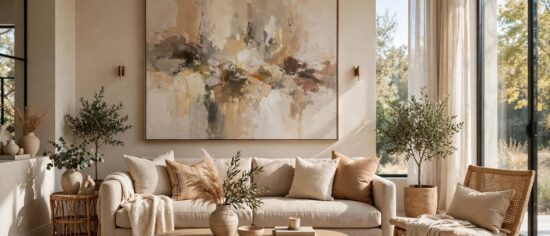
Every good wall-art decision starts with a tape measure. The rule designers return to: artwork above a sofa — or the furniture beneath it — should span about two-thirds to three-quarters of that furniture’s width. For an 84-inch sofa, that is roughly 56–63 inches wide (142–160 cm). Much smaller and the piece gets swallowed; the furniture dominates and the art looks like an afterthought.
The rule works because it makes art and furniture read as one composed group. It applies above a console table, a headboard or a sideboard too: measure the furniture, multiply by 0.66, and you have your minimum width.
The rough size bands help here. Large wall art runs about 48×24 to 71×19 inches (122×61 to 180×48 cm), with 48×36 and 60×40 inches the typical living-room workhorses. Medium pieces span 26×22 to 47×47 inches (66×56 to 119×119 cm). Small pieces — 14×11 to 22×18 inches (36×28 to 56×46 cm) — suit hallways, bathrooms, kids’ bedrooms and reading nooks, where the viewing distance is short. For one big blank wall, look for prints at least 30×40 inches (76×102 cm), or stretch the budget with a diptych or triptych — two or three panels that read as one wide composition.
Five Arrangements That Cover Most Homes
Almost every successful wall uses one of five arrangements — no need to invent a layout from scratch.
1. The statement single. One large canvas centred above the sofa or fireplace — the current 2026 lean, as rooms move away from cluttered gallery walls toward one confident focal point. Best with bold abstracts or large-scale landscapes that can hold a wall alone.
2. The classic trio. Three canvases in a row with 2–3 inches (5–8 cm) between them; the sweet spot is three prints at 20×28 inches (50×70 cm) each. Hallways and bedrooms love this one. At Activemyhouse, we see the trio used most over beds, where symmetry does the heavy lifting.
3. The gallery grid. A strict 3×3 grid of 12×12-inch (30×30 cm) squares with a consistent 2-inch (5 cm) gap. The discipline of the grid is the whole point — striking in modern and Scandinavian rooms, especially with black-and-white photography or minimalist line drawings.
4. The gallery wall. Mixed frame styles and sizes, anchored by one larger piece, with 2–3 inches between frames and one colour palette throughout. The shared palette keeps a mixed collection from looking chaotic. Stairwells and long walls are its natural habitat.
5. Leaned and layered. Smaller framed prints leaned on a console, shelf or mantel with a candle or a vase. Relaxed, changeable, and the friendliest option for renters — no nails required.
Styles That Work at Any Scale
Abstract art — bold brushwork and colour fields — suits almost any palette and is at its best at large scale. Landscape prints — rolling hills, misty mountains, coastlines — bring a calm, timeless quality to bedrooms and living rooms. Botanical and nature prints add life without demanding attention, the safest choice for a first large piece. Black-and-white photography is the great neutral across modern, traditional and farmhouse rooms. Minimalist line drawings keep small rooms feeling open, and bold typographic pieces add personality to kitchens, home offices and entryways.
If you want art that still looks right in ten years, stick to the timeless picks: neutral abstracts, black-and-white photography, botanical illustrations, and simple frames in black, white or natural wood. The current trend lean — oversized abstract canvases, botanical prints, minimalist line art, earthy tones and warm neutrals — overlaps with that list, which is a good sign: you can buy for now without regretting it later.
Wall Art Ideas, Room by Room
Above the sofa, hang one big horizontal piece sized by the two-thirds rule, or stack two prints vertically if the ceiling is high and the wall is narrow. Over the fireplace, let one large print be the star — the mantel is already a focal point, so the art should meet it at the same scale rather than compete with small frames.
In a corner nook, lean a framed print on a console with candles or a vase — the layered look turns dead space into a vignette. On floating shelves, layer smaller prints at varying depths; the overlap creates dimension and you can swap pieces seasonally without new holes. On a long blank wall, commit: a full gallery wall or one oversized piece. A single medium frame centred on six feet of empty wall is where the too-small regret lives.
Whatever the room, tie the art to what is already there. Pull two or three colours from the rug or the pillows and look for them in the artwork. The art does not have to match — contrast is fine — as long as the tone and visual balance agree.
Wall Art Sizes and Arrangements at a Glance
| Arrangement | Size / Spacing | Best For | Source |
|---|---|---|---|
| Statement single | 48×36 to 60×40 in (122×91 to 152×102 cm) | Above sofa or fireplace | House Beautiful |
| Classic trio | 3× 20×28 in (50×70 cm), 2–3 in apart | Hallways, bedrooms | The Spruce |
| Gallery grid | 3×3 of 12×12 in (30×30 cm), 2-in spacing | Modern / Scandi rooms | Real Simple |
| Gallery wall | Mixed sizes, 2–3 in apart, one palette | Stairwells, long walls | Houzz |
| Leaned / layered | Small frames on console or mantel | Nooks, shelves, renters | Architectural Digest |
| Big blank wall | At least 30×40 in (76×102 cm), or diptych/triptych | Living rooms | Better Homes & Gardens |
Frequently Asked Questions
How big should wall art be above a sofa?
Use the two-thirds rule: the art or arrangement should span roughly two-thirds to three-quarters of the sofa’s width — about 56–63 inches for an 84-inch sofa. Much smaller looks lost above the furniture.
Are gallery walls still in style?
They are, but the 2026 lean is toward restraint: one statement piece or a disciplined grid rather than a sprawling salon wall. If you love the collected look, keep one colour palette across all frames — that single decision separates a curated wall from a cluttered one.
What if my walls are small, or I’m renting?
Small walls want small art viewed up close: 14×11 to 22×18-inch pieces suit hallways, bathrooms and reading nooks. Renters should lean into the leaned-and-layered look — framed prints on a console, shelf or mantel need no nails and rearrange in minutes.
How do I choose colours for wall art?
Pull colours from the rug or pillows so the art connects to the room. You do not need to match everything; contrast works as long as tone and balance feel right. When in doubt, neutral abstracts and black-and-white photography suit nearly any palette.
Can I mix frame styles in one arrangement?
Yes — that is the gallery wall’s whole idea. Anchor the mix with one larger piece and hold it together with a single colour palette. In a strict grid, by contrast, keep the frames identical and let the spacing do the work.
Conclusion
The best wall art ideas for homes come down to fundamentals, not one perfect print. Measure the furniture, apply the two-thirds rule, pick one of the five arrangements that fits the wall, and choose a style you will still like in a decade. Size up rather than down, tie the colours to the room, and remember: the most common regret is a frame that was too small, never one that was too bold. Start with these ideas for best wall art ideas for homes, and the blank wall stops being a problem and becomes the best part of the room.