
Last updated: November 1, 2026
There is no single month that answers when to plant grass seed in spring, and anyone who hands you one is guessing. The real trigger is soil temperature — and at Activemyhouse, timing advice for every season starts there. Cool-season grasses need soil at a steady 50°F; warm-season grasses refuse to move until it is consistently past 65°F. Get that right and spring seeding works beautifully. Get it wrong and you have mostly paid to feed the weeds.
Key Takeaways
- Plant by soil temperature, not the calendar. Air temperature lies; a soil thermometer tells the truth.
- Cool-season grasses — Kentucky bluegrass, tall fescue, perennial ryegrass — want soil at 50°F or warmer, but fall is usually the better window for them anyway.
- Warm-season grasses — bermuda, zoysia, centipede — need soil consistently above 65°F; seed earlier and it sits dormant for weeks while weeds take over.
- The number-one spring mistake is seeding at the first thaw into cold, wet, compacted soil. The seed absorbs water it cannot metabolize and rots.
- Seed-to-soil contact is the whole game. Loosen, level, clear debris, and keep the seedbed consistently moist until germination.
The Real Rule: Soil Temperature, Not the Calendar
Grass seed does not own a calendar, and the calendar does not know what your soil is doing. A bright 60°F afternoon in March tells you nothing about the cold inches below, where the seed has to do its work. This is why turfgrass specialists measure soil temperature with a simple probe thermometer instead of watching the date. The rule is straightforward: cool-season grasses germinate when soil sits between 50°F and 65°F, and warm-season grasses need soil between 65°F and 75°F, with bermuda refusing to move at all below 65°F and germinating best between 70°F and 80°F.
The practical test has two parts. First, wait for 14 consecutive days of daytime highs at or above 50°F — a stretch of warmth, not a single teaser day. Purdue turf specialists back this two-week rule: one warm afternoon does not warm the ground. Second, squeeze a handful of soil: it should crumble in your fist, not stick together in a wet ball. Sticky soil is too wet and too cold, and seeding now is a donation to the weed seed bank.
When to Plant Cool-Season Grass Seed in Spring
Cool-season grasses — Kentucky bluegrass, tall fescue, and perennial ryegrass — dominate lawns in USDA zones 3 through 7, and their spring window opens as soon as the soil passes 50°F and stays there after the last frost. Rutgers turfgrass guidance pegs that 50°F mark as the germination threshold; timing slides with latitude: late February to early April in zone 7, late March to mid-April in zones 5 and 6, mid-April to early May in zones 3 and 4. Germination runs two to three weeks for ryegrass, with fescue faster than bluegrass — bluegrass is the slowest at 14 to 21 days. Starting points, not appointments — your soil thermometer has the final vote.
One caution that trips people up: 65°F is the warm-season number, not the cool-season one. Cool-season seed starts working at 50°F. Waiting for 65°F soil before seeding cool-season grass means you have waited too long — you are now seeding into warming weather that favors weeds and stresses young seedlings.
The Honest Truth: Fall Beats Spring for Cool-Season Grass
Here is the caveat an honest guide carries. Spring seeding works for cool-season grass, but fall — August through October — is usually the better window. A spring-seeded cool-season lawn heads straight into summer heat stress while it is still young and shallow-rooted, which is the hardest season for these grasses to survive. Fall-seeded grass establishes through the cool months and greets summer with mature roots.
Reading this in March? Spring seeding is a fine rescue move for bare patches — just know the seedlings will need faithful watering through their first summer.
When to Plant Warm-Season Grass Seed in Spring
Warm-season grasses — bermuda, zoysia, and centipede — own zones 7 through 11, and their rule is the mirror image: wait until the soil is consistently above 65°F. Seed earlier and it sits dormant for two to three weeks while crabgrass and other weeds take over the bare ground.
The window moves north with the season: mid-March in the Deep South, late April to early May in the Mid-South, and mid-May to early June in the Transition Zone, where warm-season and cool-season grasses meet. Bermuda has one more hard deadline, and Clemson Extension’s warm-season guidance is blunt about it: seed bermuda after June and it usually fails, because the grass needs roughly 90 days of growing season before the first frost. And never seed bermuda in late summer or fall — the seedlings will not survive their first winter.
Spring Grass-Seeding Timing by Zone
Find your zone, match your grass type, and confirm with a soil thermometer before you open the bag.
| Zone | Grass Type | Spring Seeding Window | Soil-Temp Trigger | Source |
|---|---|---|---|---|
| Zone 7 | Cool-season (bluegrass, fescue, ryegrass) | Late Feb–early Apr | Soil holds ≥50°F | Rutgers NJAES Turfgrass |
| Zones 5–6 | Cool-season (bluegrass, fescue, ryegrass) | Late Mar–mid-Apr | Soil holds ≥50°F | Purdue Turf Science |
| Zones 3–4 | Cool-season (bluegrass, fescue, ryegrass) | Mid-Apr–early May | Soil holds ≥50°F | Iowa State Extension |
| Deep South (zones 8–9) | Warm-season (bermuda, zoysia) | Mid-Mar | Soil consistently ≥65°F | Clemson Extension |
| Mid-South (zones 7–8) | Warm-season (bermuda, zoysia, centipede) | Late Apr–early May | Soil consistently ≥65°F | NC State Extension |
| Transition Zone | Bermuda | Mid-May–early Jun | Soil 65–75°F | UC Agriculture and Natural Resources |
Microclimates and soil type can shift every window by weeks — the soil-temperature trigger in the fourth column is the number that actually decides.
The Mistake to Avoid: Seeding at the First Thaw
The number-one spring mistake has a name: seeding at the first thaw. The snow is gone, the sun is out, and the bare patches look terrible — but the soil is still cold, wet, and compacted. Grass seed in those conditions absorbs water it cannot metabolize and rots instead of germinating. Worse, the freeze–thaw cycles of early spring heave the soil surface and can push any seedlings that do emerge right out of the ground.
The second half of the same mistake is seeding cool-season grass into mid-summer heat. If you missed the spring window, waiting for fall is usually smarter than forcing a doomed summer seeding.
How to Plant Grass Seed Right Once the Timing Is Right
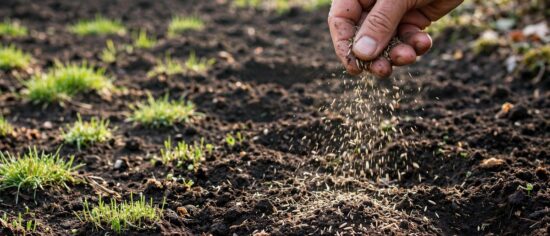
The whole game is seed-to-soil contact — seed sitting on thatch or hard ground germinates poorly no matter how perfect the temperature is. Loosen the top two to three inches with a rake or cultivator, remove sticks, stones, and dead grass, and level low spots so water does not pool.
Spread the seed at the rate on the bag, press it lightly into the soil with the back of a rake or a lawn roller, and keep the seedbed evenly moist until germination — usually light watering once or twice a day, not a weekly flood. Do not mow until the grass is established: roughly eight to ten weeks for bluegrass, four to six for fescue, two to three for ryegrass.
Frequently Asked Questions
What is the best month to plant grass seed in spring?
It depends on your zone and grass type: cool-season grasses go in once soil holds at 50°F (roughly March in the Mid-Atlantic, April in the Upper Midwest), while warm-season grasses wait for soil past 65°F — May or June further north. Use the zone table and a soil thermometer, not the calendar.
What soil temperature is needed for grass seed to germinate?
Cool-season grasses germinate at 50°F to 65°F soil temperature. Warm-season grasses need 65°F to 75°F, and bermuda does best between 70°F and 80°F. Air temperature is not a substitute — measure the soil directly with a probe thermometer.
Is it too late to plant grass seed in June?
For cool-season grass, June is usually too late — waiting for fall is smarter. For warm-season grass in the Transition Zone and north, June is the tail end of the window; bermuda seeded after June typically fails because it needs about 90 days before the first frost.
Should I plant grass seed in spring or fall?
For cool-season grass, fall (August through October) is usually better — seedlings establish through the cool season and handle summer better the next year. Spring works as a rescue for bare patches. For warm-season grass, late spring is the correct and only practical window.
Conclusion
Getting the timing right is most of the battle, and the rule is simpler than the calendar makes it look: cool-season grass wants soil at 50°F and usually does best in fall anyway; warm-season grass wants soil past 65°F and rewards patience. Follow this guide for when to plant grass seed in spring, confirm your soil temperature, dodge the first-thaw trap, and give the seed real soil contact and steady moisture — and your lawn gets the head start it deserves.