
Last updated: October 28, 2026
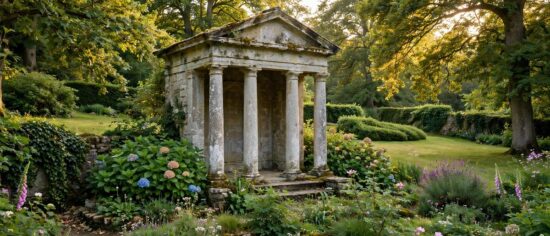
A garden folly is an ornamental building with no practical purpose at all — it exists only to be looked at, to create atmosphere, and to give a garden a focal point worth walking toward. Once you understand what is a garden folly, you stop asking what it is for, because a folly’s only job is to delight.
Key Takeaways
- A garden folly is built for show, not for use.
- The word comes from the French “folie”, meaning delight or a favourite abode.
- Follies reached their golden age in 18th-century English and French landscape gardens.
- Famous follies include Roman temples, ruined abbeys, pyramids, pagodas and grottos.
- A modern folly can be a small temple, arch or tower — and can hide a shed or compost heap.
- A shed, greenhouse or gazebo is not a folly: those structures have a job.
What Is a Garden Folly?
A garden folly is a building that pretends to be something it is not. It may look like a Roman temple, a ruined abbey, a pyramid or a small tower, but behind the facade there is usually nothing at all — no rooms to live in, no tools to store, no shelter to sit under. It is architecture as decoration.
That definition separates a folly from every other garden structure. A shed stores things, a greenhouse grows things, a gazebo seats people. A folly does none of those things: it stands in a garden to be looked at, and to give the eye somewhere to rest.
It works best as part of the landscape: 18th-century gardeners placed follies where a view needed a destination — on a rise, at the end of a vista, half-hidden by trees. Crammed into a corner, a folly loses its effect.
Where Does the Word “Folly” Come From?
The word “folly” comes from the French “folie”, which meant delight, or a favourite abode. In English, the Oxford English Dictionary records it as “a popular name for any costly structure considered to have shown folly in the builder”. The name carries a joke: these were expensive buildings with no use, and neighbours thought spending so much on decoration was foolish.
The joke was part of the point: building a folly displayed wealth and taste. A landowner who could afford a ruined abbey that had never been real was showing that even his ornaments were built in stone.
A Short History of the Garden Folly
The first follies were costly structures on wealthy English estates in the late 16th and early 17th centuries. The golden age came in the 18th century, when English and French landscape gardens became the fashion: Stowe and Stourhead in England, Ermenonville and Versailles in France, all set temples and ruins into landscapes meant to be discovered on a walk.
Designs were often copied from landscape paintings: artists such as Claude Lorrain and Hubert Robert painted idealised landscapes dotted with ruins and temples, and garden owners built those paintings in real life. That is why so many follies look like something from a picture: a Roman temple, a ruined abbey, a pyramid, a pagoda, a bridge, a tent in stone, a grotto, or a farmhouse such as Marie Antoinette’s Hameau de la Reine at Versailles.
Follies With a Meaning
Many follies carried meaning. Ermenonville’s Temple of Philosophy was left unfinished to symbolise that knowledge is never complete, and Stowe’s Temple of Modern Virtues was deliberately ruined to show the decay of contemporary morals. The message was built into the stone.
Some follies were built for a different kind of purpose altogether. During the Irish Potato Famine, follies were built to provide employment for peasants and artisans, giving work to people who desperately needed it. The buildings were still ornamental, but their construction was an act of relief.
One detail belongs in the past: in the 18th century, a few owners employed a resident hermit to live in their folly. It was a Georgian eccentricity, not a modern practice.
Follies in the United States
The folly tradition crossed the Atlantic. Bishop Castle near Pueblo, Colorado, is a vast stone castle built by one man over decades. Bancroft Tower near Worcester, Massachusetts, is a stone memorial tower. Lucy the Elephant in Margate City, New Jersey, is a six-storey elephant-shaped building that has served as a landmark since the 19th century. Kingfisher Tower, a 60 ft (18 m) structure at Otsego Lake, New York, rises from the shore as a purely decorative Gothic tower. Whatever the form, the principle is identical: built to be seen, to mark a place, to give a landscape a focal point.
Types of Garden Follies
The table below brings the most common types together — all built to be looked at, not to be used.
| Type | Form | What It Adds to a Garden | Source |
|---|---|---|---|
| Roman temple | Columns on a rise | A classical focal point | The Folly Fellowship |
| Ruined Gothic abbey | Broken arches | Romance and age | Historic England |
| Egyptian pyramid | A pyramid on a lawn | Drama and silhouette | Country Life |
| Chinese pagoda | Tiered roofs | An exotic accent | The English Garden |
| Shell grotto | A shell-lined cave | A hidden surprise | Gardenista |
| Hermit’s retreat | A cottage in a dell | A storybook destination | Smithsonian Magazine |
A folly can also be an arch, a spire, a tower or a single wall: a temple for an open lawn, a grotto for a bank, a ruined arch for a woodland edge.
How to Use a Folly in a Modern Garden
A folly is not only for grand estates. Most often it is a focal point: a small temple, pyramid, arch or tower at the end of a path gives the eye a destination and makes a garden feel larger. Tucked away, it becomes a surprise in a “secret garden” corner.
It can also hide things: a shed or compost heap behind a ruin-like Gothic wall, or a barbecue or pizza oven built into the back, so the garden sees only the decorative face.
Building one is a realistic DIY project: concrete, stone, wood, or plywood with a stone veneer. Keep it modest, with planting and a path.
Modern versions also include pergolas, gazebos, arbors and sculptures — but a pergola that shades seating is functional, and a true folly only pretends to be a building. If it has a job, it is not a folly.
What Is Not a Folly?
A shed is not a folly, because it stores things. A greenhouse is not a folly, because it grows things. A seating gazebo is not a folly, because it shelters people. A garden office is not a folly, because it is a workplace. Every one of those is a useful garden building, but none of them is a folly.
The test is simple: take it away — would the garden lose a place to sit, store or work? If yes, it was never a folly.
Guides on Activemyhouse follow the same rule: judge a garden structure by what it does, not by what it looks like.
Frequently Asked Questions
What is the difference between a folly and a gazebo?
A gazebo shelters people; a folly is ornamental only, with no practical use.
Can I build a garden folly myself?
Yes. Common materials are concrete, stone, wood, or plywood with a stone veneer. Keep it modest, and check local planning rules first.
Do I need planning permission for a garden folly?
It depends on size and distance from a boundary. Small, low ornaments usually need no permission, but a tall tower or a structure near a boundary may do. Check local rules first.
What is the most famous garden folly?
Stowe and Stourhead in England are the classics; the Hameau de la Reine at Versailles is the most famous cottage folly, and Lucy the Elephant in New Jersey the best known in America.
Can a folly hide something ugly in my garden?
Yes. A Gothic wall can screen a shed or compost heap, and a barbecue or pizza oven can sit behind a facade — the garden sees the folly, the work stays hidden.
Conclusion
A garden folly is a reminder that a garden does not have to justify every square foot: some things earn their place by being useful, others by being beautiful, and a folly belongs firmly in the second group. Temple, ruined abbey, pyramid or single wall, its job is the same — to give the eye somewhere to go.
If you are planning one, start small, choose a form that suits your garden, and set it with planting and a path — which is exactly what what is a garden folly is all about.