
Last updated: October 28, 2026
Cultured marble looks like real marble at a fraction of the price, but it scratches more easily than stone, hot tools can scorch it, deep chips are hard to repair invisibly, and the gel coat can dull and crack with age. Here are the disadvantages of cultured marble, stated honestly, so you can decide before you buy.
Key Takeaways
- Cultured marble is crushed marble and resin, cast in a mould and sealed with a clear gel coat — non-porous and seamless.
- Its biggest weakness is the gel coat: it scratches, scorches, stains once damaged, and ages into cracks and dullness.
- A deep chip through the gel coat is hard to fix invisibly, even with a colour-matched filler.
- It can look plastic next to real marble, and it holds less resale prestige than natural marble, granite or quartz.
- It is still a durable budget pick for a lower-traffic bathroom.
What Is Cultured Marble?
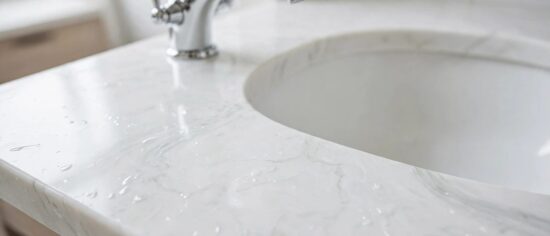
Cultured marble is not quarried stone. It is crushed marble mixed with resin, cast in a mould and finished with a clear gel coat. That gel coat makes it non-porous — resistant to water, stains, mildew and bacteria — and allows seamless integrated pieces: countertop, sink bowl and backsplash as one unit.
It is typically cheaper than quarried granite or natural marble, and custom sizes are readily available.
It Scratches More Easily Than Stone
The first disadvantage most owners notice is scratching. The gel coat scratches more easily than natural stone or quartz: a sharp object, an abrasive scrub pad, a dropped curling iron or a heavy ceramic planter dragged across the surface can leave semi-permanent marks.
That matters more than it sounds, because a scratch is not just cosmetic. Once the gel coat is compromised, the material underneath can absorb stains that the intact surface would have shrugged off. Lift heavy objects instead of dragging them, and keep scouring powders out of the bathroom.
It Has Low Heat Resistance
The second weakness is heat. Hot hair tools such as a flat iron or curling iron, or a hot pan left directly on the surface, can scorch or blister the gel coat, leaving a permanent yellowed or discoloured mark that cannot be wiped away.
Always use a protective pad under hot tools and a trivet under hot pans. Quartz and granite tolerate far more heat, so if hot tools landing on the counter is part of your daily routine, this disadvantage deserves real weight in your decision.
Deep Chips Are Hard to Repair Invisibly
Minor scratches can sometimes be buffed out by a professional, but a deep chip that goes through the gel coat is a different story. It needs a colour-matched filler, and even a careful repair may still show — especially on darker or patterned surfaces, where the filler line catches the light differently from the surrounding material.
That is the repair problem in a sentence: the damage is easy to make and hard to hide. If you do chip a cultured marble top, get a professional to look at it rather than reaching for a DIY filler — a bad home repair usually makes the spot more visible, not less.
The Gel Coat Ages: Cracks and Dulling
The fourth disadvantage appears slowly, over years. With age, the gel coat can develop small branching cracks that extend through the material, and the high-gloss sheen that made the top look new can dull over time. Restoring it means refinishing, not just a wipe-down.
A cultured marble top can look flawless on day one and tired after a decade of daily use. Refinishing can restore much of the shine, but it is an added cost buyers rarely budget for.
It Can Still Stain Despite the Non-Porous Claim
Cultured marble is sold as non-porous, and a good-quality top with an intact gel coat genuinely resists stains well. But low-quality cultured marble can stain from toothpaste, juice and other acidic compounds, and the claim is only as good as the surface.
Worse, the wrong cleaner can undo the protection. Abrasive or acidic cleaners — including vinegar-based DIY cleaners and nail polish remover — can wear down the protective layer, and once it is thinned, stains that would never have taken hold start to appear. Use mild, pH-neutral cleaners, and keep vinegar solutions and nail polish remover away from the surface.
It Can Look Plastic and Hold Less Value
The sixth disadvantage is about looks and value. Cultured marble can look plastic, and it lacks the depth, veining and organic feel of real marble: real marble has variation running through the stone, while cultured marble has a pattern sitting on the surface.
It also holds less intrinsic value and resale prestige than natural marble, granite or quartz. Quartz is the comparison that stings most: it is naturally non-porous, more scratch-resistant and more heat-resistant than cultured marble, and often in a similar budget tier. On durability per dollar, quartz deserves a serious look before you commit.
How Cultured Marble Compares
| Material | Scratch Resistance | Heat Resistance | Repair | Source |
|---|---|---|---|---|
| Cultured marble | Lower — gel coat scratches easily | Low — scorches and blisters | Hard to hide a deep chip | Engineer Fix |
| Quartz | Higher — harder surface | Higher — tolerates more heat | Chips can be filled more discreetly | Hunker |
| Natural marble | Moderate — scratches, but can be honed | Moderate — better than gel coat | Can be honed and resealed | Archiscene |
| Granite | High — very hard surface | High — handles hot pans well | Chips need professional repair | HPD Consult |
| Solid surface | Moderate — scratches, but sandable | Low to moderate | Scratches can be sanded out | My Blue Bath |
White Glossy Finishes Show Everything
The seventh disadvantage is the most mundane, and the one owners complain about most often. White glossy finishes show everything — hair, soap suds, makeup, dust and toothpaste — so the top needs regular cleaning to stay spotless.
This is partly a colour choice, not a material flaw — a darker or patterned top hides daily mess far better. But white is the most popular finish, so most buyers live with exactly that combination. If you dislike daily wiping, choose a matte finish or a busier pattern.
Who Should Still Consider Cultured Marble?
After all of that, cultured marble is still a reasonable buy for the right situation. It is durable overall, a good budget pick for a lower-traffic bathroom, and the seamless integrated sink leaves nowhere for grime to collect. A guest bathroom or a powder room, where the top sees light use and few hot tools, is where cultured marble makes the most sense.
It makes less sense in a busy family bathroom, where the money saved up front can be spent later on refinishing or replacement.
The rule, as guides on Activemyhouse put it for every material choice, is to match the material to the room’s real traffic, not to the showroom. If your bathroom is calm and lightly used, cultured marble’s disadvantages may never show up. If it is the busiest room in the house, they will.
Frequently Asked Questions
Does cultured marble scratch easily?
Yes, more easily than natural stone or quartz. Sharp objects, abrasive pads and heavy items dragged across it can leave semi-permanent marks, and once the gel coat is broken the material underneath can absorb stains.
Can you put a hot flat iron on cultured marble?
No, not directly. A hot flat iron or curling iron can scorch or blister the gel coat and leave a permanent yellowed mark. Always set hot tools on a protective pad or mat, never straight on the surface.
Can a chipped cultured marble top be repaired?
Minor scratches can sometimes be buffed out by a professional. A deep chip needs a colour-matched filler and the repair may still show, especially on darker or patterned surfaces.
Does cultured marble stain?
A good-quality top with an intact gel coat resists stains well. Low-quality cultured marble can stain from toothpaste, juice and other acidic compounds, and abrasive or acidic cleaners — including vinegar-based cleaners and nail polish remover — can wear down the protective layer.
Is cultured marble better than quartz?
Quartz is naturally non-porous, more scratch-resistant and more heat-resistant than cultured marble, and often in a similar budget tier. Cultured marble is usually cheaper and offers seamless integrated sinks, so the better choice depends on whether price or durability matters more to you.
Conclusion
Its weaknesses all live in the same thin layer. The gel coat scratches, scorches, stains once damaged, and dulls and cracks with age, while the look stays flatter than real marble and the resale value stays lower than stone or quartz. If your bathroom is lightly used and you treat the surface gently, those disadvantages of cultured marble may never trouble you. If it is a busy family bathroom, they will — and knowing that before you buy is the whole point.