
Last updated: October 27, 2026
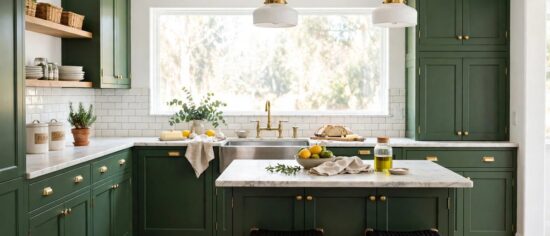
Sherwin Williams hunter green is a true, deep dark green, not teal and not olive, and it works best as an accent or on cabinetry and trim. Sherwin-Williams sells it as Dard Hunter Green, SW 0041, with an LRV of 6, so sample it first.
Key Takeaways
- Sherwin Williams hunter green is Dard Hunter Green, SW 0041 — spelled “Dard”, not “Dark”.
- It is a true dark green with neutral undertones, not teal or olive.
- Its LRV is 6, so it is very dark and best in rooms with good natural light.
- It works best on kitchen cabinets, bathroom vanities, trim, and front doors.
- Benjamin Moore Hunter Green is very close, with an LRV of 6.39.
What Is Sherwin Williams Hunter Green?
Sherwin Williams hunter green is the paint company’s classic deep green, sold as Dard Hunter Green, SW 0041.
The name surprises people. “Dard” is not a typo for “Dark” — it is the actual name on the Sherwin-Williams color card, and several reviewers say they first assumed it was a printing error. If you ask for it with the wrong spelling in a store, you may still be understood, but the can will say Dard Hunter Green.
That matters because there is no separate Sherwin-Williams color called “Hunter Green” with a different code. The whole article is about this one shade: Dard Hunter Green, SW 0041.
Is Dard Hunter Green Teal or Olive?
It is neither. Dard Hunter Green is a true, deep dark green with neutral undertones.
Reviewers chose it for exactly that reason. Teal leans blue, and olive leans yellow, and both can pull a room in a direction the owner did not want. Dard Hunter Green stays green. One reviewer described it as “if you tinted Kelly green super dark,” which captures the feel: a bright, clear green pushed down into the dark range, without drifting toward blue or yellow.
That neutrality is why it works in both modern and traditional spaces: it fits a classic kitchen, a traditional dining room, and a modern entryway alike.
How It Compares to Other Dark Greens
Not every dark green behaves the same way, and the differences show up fast once the paint is on the wall:
- Benjamin Moore Hunter Green is very close — “full of depth and elegance” — with an LRV of 6.39, a touch lighter than SW 0041.
- SW Isle of Pines and SW Evergreens are other Sherwin-Williams dark greens, but they are different shades, not substitutes.
- SW Pewter Green is more gray than green.
- SW Rookwood Dark Green, from the historic collection, is lighter, with an LRV of 10.
The table below puts the main contenders side by side.
| Color | Brand/Code | LRV | Undertone | Source |
|---|---|---|---|---|
| Dard Hunter Green | Sherwin-Williams SW 0041 | 6 | Neutral, true green | Kaitlin Madden |
| Hunter Green | Benjamin Moore | 6.39 | Deep, elegant green | A House in the Hills |
| Rookwood Dark Green | Sherwin-Williams | 10 | Historic dark green | Kaitlin Madden |
| Pewter Green | Sherwin-Williams | — | More gray than green | A House in the Hills |
How Dark Is Hunter Green?
Very dark. Dard Hunter Green has an LRV of 6 on the 0–100 scale, where 0 is black and 100 is white.
That number is the single most practical fact about the color. At LRV 6, a wall painted in this shade absorbs most of the light that hits it. In a bright room with large windows, that reads as drama and depth. In a dim room, it can read as a cave.
So the darkness is a feature, not a flaw — as long as you plan for it. Reviewers loved it on trim and cabinets, but said a whole room in this color would have been too dark even in a bright space.
What LRV 6 Means in Practice
- The color looks almost black in weak light and in the evening.
- In strong daylight, the green comes forward and the depth shows.
- White or pale trim next to it makes the green look richer, not darker.
Where Should You Use Hunter Green?
Use it where a dark green can be an accent, not where it has to carry a whole room.
The best uses from real projects are kitchen cabinets, a bathroom vanity, an accent wall or the lower half of a wall, trim, and a front door. In each of those spots, the dark green is a statement against lighter surroundings, and the room keeps its light.
Follow these steps to place it well:
- Pick one surface first — cabinets, a vanity, or a door — and let the rest of the room stay light.
- Check the light at different times of day, because the green shifts a lot between morning and evening.
- Paint a large sample on the actual wall or cabinet, not just a small swatch.
- Live with the sample for a few days before you buy the full amount.
- Keep the trim and ceiling pale so the green reads as an accent.
Paint guides on Activemyhouse give the same advice for every dark color: sample on the real surface, in the real light, before you commit.
What Colors Pair With Hunter Green?
Dard Hunter Green pairs well with colors the reader already has and with natural wood.
Because its undertones are neutral, it does not fight warm or cool companions. Natural wood warms it up, white and cream trim sharpen it, and brass picks up its classic side while matte black hardware pushes it more modern.
The pairing rule is simple: keep the companions light. A dark green with dark companions makes a room feel smaller and heavier. The same green next to white trim, pale walls, or light wood reads as rich and deliberate.
Always sample the combination on the actual wall — two colors that look fine on paper can behave differently once the green goes on at LRV 6.
Hunter Green in a Small or Dim Room
This is the edge case where hunter green needs honesty. A small, dim, north-facing room is the worst place for a whole wall of Dard Hunter Green.
In weak northern light, the green loses its color, the walls go dark, and the room feels smaller than it is. No amount of pale furniture fully fixes that, because the walls themselves absorb the light.
That does not mean the color is banned from small rooms. A front door, a single vanity, or a narrow strip of trim adds the same classic color without darkening the room — the trick is scale.
Frequently Asked Questions
What is the Sherwin-Williams hunter green paint code?
The code is SW 0041, and the full name is Dard Hunter Green — spelled “Dard”, not “Dark”.
Is “Dard” in Dard Hunter Green a typo?
No, “Dard” is the real name on the Sherwin-Williams color card. Reviewers note they first assumed it was a typo, but every source spells it the same way.
Is Sherwin Williams hunter green teal?
No, it is not teal. Dard Hunter Green is a true dark green with neutral undertones, so it does not lean blue the way teal does.
Is Sherwin Williams hunter green olive?
No, it is not olive. Olive leans yellow, while Dard Hunter Green stays a clear, deep green without a yellow cast.
How dark is Dard Hunter Green?
Its LRV is 6, which is very dark on the 0–100 scale. It looks almost black in weak light and shows its green best in strong daylight.
Can I use hunter green in a small room?
Yes, but only as an accent — a vanity, a door, or trim. A whole wall of Dard Hunter Green in a small, dim room will make the room feel darker and smaller.
Conclusion
The honest case for sherwin williams hunter green is simple: it is a true dark green with the spelling Dard Hunter Green, SW 0041, and an LRV of 6 that makes it dramatic as an accent and too dark as a whole room. Sample it on your wall, keep the companions light, and let the green do the talking.